

To Become a Theologian

On May 25, 2016, theologian John Webster died. No one was prepared for it. Like many theologians of his generation, he died too young, but his impact was immense.

The reason I want to the University of Aberdeen to study theology was that John Webster was the main professor in that department. He had just hired a series of younger theologians under him, one of whom became my supervisor, and he established an incredibly vibrant theological community in that place.
Those years at Aberdeen were incredible. But the lesson I learned at that place was not a short-term vision. It was a vision for a certain kind of life. A theological life.
By the time I had met John I already heard from the theologians I respected that he was the greatest living theologian of his day. But John’s legacy, in many ways, was about the recovery of a truly theological rationality. One of his main lines of inquiry in those years was: How can we think theologically in the university today?
But even beyond the university, Webster’s theological vision was about reasoning in the presence of God for the sake of his church. Webster argues that theology “is properly undertaken in the sphere of the Church, that is, in the region of human fellowship which is brought into being and sustained by the saving activity and presence of God.”
“Theology is one of the effects of that saving presence;” Webster argued, and “it is one of the activities of reason transfigured by the renewal of human life and history which the holy God effects in his works and makes manifest in his word.” In this sense, “theological reason is an activity of the regenerate mind turned towards the gospel of Jesus Christ, which constitutes the Church’s origin and vocation.”
Becoming a Theologian
Webster’s legacy establishes a path for becoming a theologian. Webster’s theological vision was one where God remained centered, not just formally but materially, in all that he did. The temptation of the theologian was to allow their thinking to gravitate away from God, or to make God into a really huge creature, and therefore fail to really consider God himself.
But Webster’s vision was not a disembodied ideal. John established in his own life, and in that community, a certain path to embrace the maturation of a theologian. Key to that path was a patient attention to Scripture, to be sure, but it was also the willingness to sit at the feet of the great minds of Christian history. The theological vision that Webster articulated was not merely taught; one had to absorb it by patiently attending to the contours of sanctified reason.
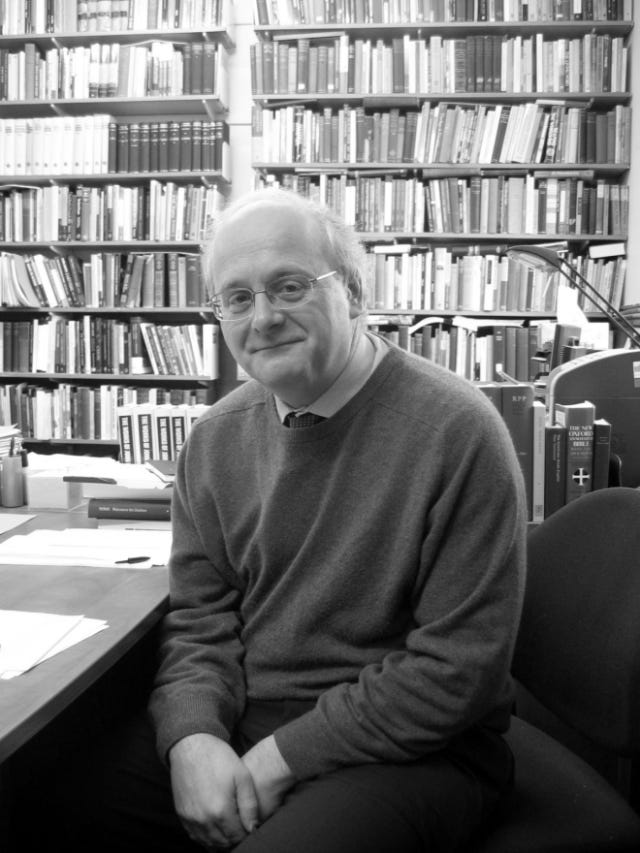
The picture of John above is exactly how I remember him in his office. John was incredibly gracious to me. Even though I wasn’t his student he agreed to meet with me regularly. I remember that edition of The Works of John Owen sitting on his desk. You could tell what was currently on his desk because of who he quoted in his recent work, and it ended up being incredibly wide-ranging (in those days it was a lot of Aquinas, Owen, and Edwards, along with his ever-present wrestling with Barth). In the task of theological reasoning, it didn’t really matter who you were sitting with, as long as you were sitting with one of the thinkers of the church who had been weighed by the church.
For many, Webster became the theologian who helped us think about doctrinal construction and location. He was always articulating, not only what a doctrine was about, but what sort of shape and size it was in a broader theological vision. But his enduring influence, I think, will be his vision for a truly theological theology. This was his refusal to leave the ground and rationality of theology for something else, often something more “cutting-edge” that the modern university was enamored with.
A truly theological rationality was formed by other contours than those of modern science. “Caught up by the Holy Spirit into the reconciling work of god in Christ,” Webster argued, “reason is condemned and redeemed, torn away from its evil attachment to falsehood, vanity and dissipation, and so cleansed and sanctified for service in the knowledge of the truth of the gospel.”
This is a vision for theology before the face of God.
This is why Webster himself, and his students, tend not to publish constructive work quickly. I am often asked why theological dissertations coming out of that school of thought almost always focus on a single individual. It is because the church needs nothing less than freshly minted PhD’s writing constructively. Theological reason is hard won over a life. The path to becoming a theologian is to patiently sit at the feet of Scripture and the way that the tradition has heard Scripture, allowing those voices to confront you with your flesh, your modern presuppositions, and your tendency to gravitate away from God to talk about other things.
But while Webster represents a kind of academic theology, albeit one that is explicitly churchly, I want to highlight the call for all Christians to embrace a theological rationality. Instead, what I often see, is an attempt to tack Christianity on to an already established way of reasoning. Instead of reason condemned and redeemed, I typically find reason simply affirmed. For example, what often goes by the name “integration” is just reason affirmed; what we call integration is too often secular reason with Bible verses pasted on the end.
To embrace the call of a truly theological way of reasoning is to find oneself utter captivated by God and his gospel. It is a refusal to bypass this for other ground and a refusal to reason about your life apart from this fact. But this means that it is also a refusal to reason apart from the cross.
For my paid subscribers, I want to think a bit more about the nature of this sort of reasoning and what it takes to embrace this call. Take a look at the video below.
My commitment to this Substack is to provide reflections for free that can help the church wrestle deeply with spiritual formation. But I am also committed to a more engaged path with my paid subscribers. Your support is a profound help to me and a way to participate more directly in engaging these questions.
My paid subscribers can comment on posts, have access to mini-courses, and can engage in the paid subscribers chat. I often take these questions and write posts devoted to answering them, and I commit to engaging these comments and questions quickly and deeply.
If you want to wrestle with these questions more, and want a bit more engagement in doing so, please consider upgrading to a paid subscription.